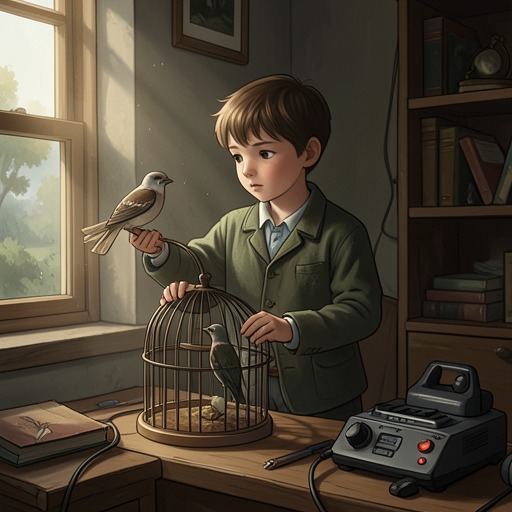
Frederick’s profound cognitive impairment
All the Light We Cannot SeeFrederick’s profound cognitive impairment defines the quiet, dependent routines of his postwar life, while leaving uncertain what he can still perceive or remember. His mother feeds and cares for him, the doctors describe his brain as retaining only basic functions, and yet his words and reactions resist a wholly settled account of what remains within him. Around that uncertainty, a returned letter and a bird print bring Werner back into the household’s present.
Daily Life and Dependence
Frederick’s condition is shown through ordinary acts of care rather than a clinical inventory. His mother purees his vegetables, places the spoon in his mouth, wipes his chin, and sets paper before him. He hums as he swallows, apparently happy, then takes a pencil and draws. These routines make the extent of his dependence concrete: his mother anticipates and supplies his needs, while his drawing is one of the few actions the narrative shows him initiating for himself.
The household’s quiet is also part of that routine. Frederick’s mother measures rice, switches on every lamp and overhead fixture, and takes him onto the elevated patio, where he sits with a bib around his neck and stares into space. The lights do not answer a practical need to see; she turns them on because she is alone and because they make her feel as if she is expecting someone. Her care for Frederick and her own isolation occupy the same rooms, shaping a life organized around repeated gestures and the hope that someone may still arrive.
Memory and the Bird Print
The doctors say that Frederick retains no memories and that his brain maintains only basic functions. His mother does not dismiss their judgment, but she wonders whether there are moments when it is incomplete. When a folded color print arrives in an old envelope, she smooths its creases, brings a floor lamp closer, and places the image before him. It shows a male and female aquatic wood wagtail perched on a stalk of Indian turnip. Frederick tilts his head; she tries to believe that he is studying it. After a moment, however, he returns to drawing spirals.
The image carries a history the doctors’ account cannot resolve. Frederick’s mother remembers buying a book for him and the bookseller taking a long time to wrap it. She had not understood the book’s attraction, but knew her son would love it. The print recalls that earlier act of choosing something for him, although no note explains why it has been sent or what he makes of it now. His mother intends to try again the next day. The scene neither proves that he remembers the book nor closes off the possibility; instead, attention, recognition, and repetition remain difficult to distinguish.
A Letter Returns the Past
The envelope comes after a long chain of wartime and postwar transfers described in a letter from a woman in Essen. The smaller envelope has passed from her brother to an American prisoner-of-war camp in France, then to a military storage facility in New Jersey, a veterans’ service organization in West Berlin, a former sergeant, and finally the woman who writes to Frederick’s mother. The wrinkled, sepia-colored envelope bears Frederick’s name in small cursive letters. His mother shows it to him, but he shows no interest; she leaves it on the counter until dusk before opening it herself.
Inside is the bird print, but no explanation. Its journey makes an object outlast the wartime separations and administrative handoffs that have obscured its meaning. Frederick’s mother recognizes the connection to the book she once bought, while the envelope itself provides no assurance that Frederick recognizes either the image or its history. What reaches him is therefore both a tangible remnant of the past and a question his mother cannot answer on his behalf.
Words, Recognition, and Uncertainty
On another evening, Frederick calls to his mother and asks, “What are we doing, Mutti?” She answers that they are sitting and looking out at the night. The question is direct, but the scene does not explain whether it signals a return of memory, a moment of awareness, or something else. His body becomes rigid before he speaks: his fingers lock around the arms of the chair, and the veins in his neck stand out. The intensity of the gesture makes the exchange striking without turning it into proof of recovery.
Frederick’s mother continues to attend to him without claiming certainty about his inner life. She will show him the bird print again; she watches for his response to starlings crossing the city in great swarms, sometimes thinking he perks up at the sight or sound of their wings. These observations are modest and provisional. His impairment is not presented as a mystery solved by one extraordinary utterance, but as an ongoing condition in which care depends on close attention and interpretation remains fragile.
Wartime Memory and Its Afterlife
The letter also restores Werner to Frederick’s mother’s memory as her son’s one friend. When she recalls the boy with white hair, shy hands, and a melting smile, she says, “He was very small.” The print and the message thus connect Frederick’s present care to a friendship formed before the war’s aftermath divided their lives. His mother has spent decades hiding herself and what happened to her boy, like other widows made to feel complicit in an unspeakable crime. Opening the envelope is a small breach in that concealment, though Frederick himself does not show interest in it.
The scene holds two forms of uncertainty together: what Frederick may still remember, and what survivors can bear to retrieve. His mother flattens the print’s creases and tries it with him again, while the surrounding story gives the returned letter the force of a belated witness to a lost friendship. Frederick’s impairment remains neither overcome nor explained away. It shapes how he lives and how others care for him, while his mother’s repeated attempts to reach him keep open a narrow space between what can be observed and what cannot be known.